
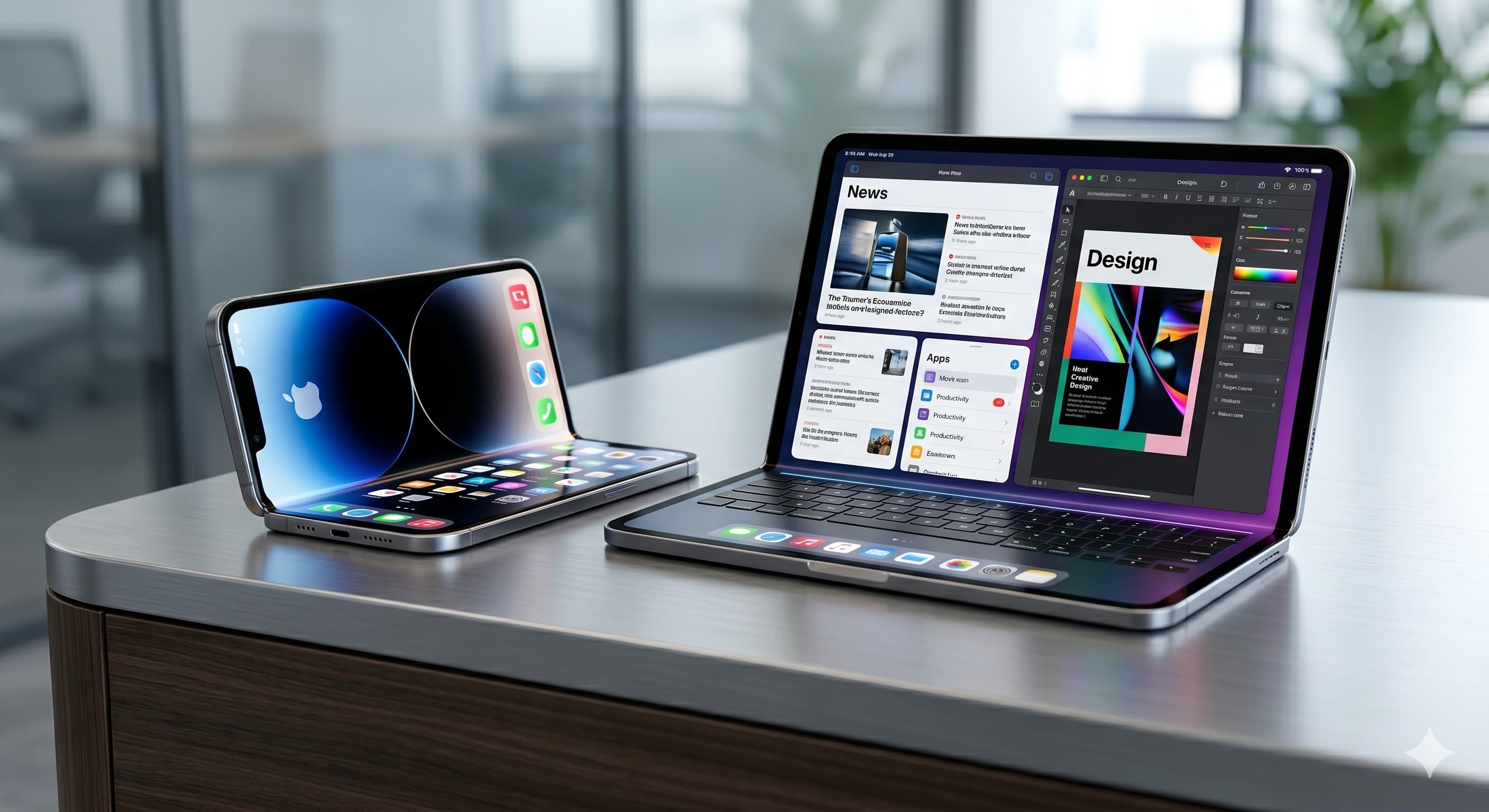
Apple has finally entered the foldable market with two groundbreaking devices: the iPhone Fold and the iPad Fold. After years of secrecy and over 500 patents, Apple’s take on foldables focuses on solving the two biggest pain points of current foldables: crease durability and software continuity. The iPhone Fold features a 6.1-inch outer display (when folded) and a 7.9-inch inner OLED screen with a near‑invisible crease, thanks to a new hybrid glass‑polymer display developed with Corning. The hinge uses a titanium‑encased 4‑bar linkage with self‑cleaning brushes to keep dust out, rated for 500,000 folds. Under the hood, both devices run Apple’s M5 chip (3nm enhanced) with a 16‑core Neural Engine, enabling seamless transitions between folded and unfolded states. The real innovation is FoldOS – a unified operating system that dynamically switches between iOS and iPadOS layouts depending on fold angle and context. The iPad Fold is a larger sibling: a 13‑inch tablet that folds into a 9‑inch notebook‑like form factor, complete with a built‑in kickstand and support for the new Apple Pencil Pro 3 (which attaches magnetically to the spine). Both devices include under‑display Face ID 2.0 (TrueDepth camera hidden beneath the outer and inner screens), Wi‑Fi 7, and a new 2‑nanometer baseband for satellite connectivity. Pre‑orders begin December 2026, with shipping March 2027. This article covers design, specs, software, pricing, and how Apple’s approach beats Samsung and Google.
Display Tech: How Apple Beat the Crease
Apple spent four years working with Corning to create the ‘Ceramic Shield Fold’ – a three‑layer stack: bottom UTG (0.1mm), middle silicone‑based elastic polymer (50µm), top nano‑ceramic layer (20µm) that is harder than sapphire but flexible. The polymer layer distributes bending stress over a 5mm radius, preventing micro‑cracks. Result: less than 5µm crease depth after 200,000 folds vs 80µm on Z Fold 5.
Performance & Battery Life: All‑Day Foldable
M5 chip delivers 35% faster single‑core and 45% faster multi‑core than M4. Battery is a dual‑cell 5,200 mAh (iPhone Fold) and 9,800 mAh (iPad Fold). With efficient displays and M5’s power gating, iPhone Fold gets 10 hours of unfolded use (inner screen) or 15 hours folded (outer screen). Fast charging: 45W wired (0‑50% in 15 mins), 25W MagSafe 2.0.
FoldOS Deep Dive: Apps That Adapt
Developers use the new `UIFoldTransition` API to define three layouts: compact (folded), regular (unfolded portrait), and expanded (unfolded landscape). The OS keeps a snapshot of each layout and transitions with a crossfade + scale animation. Apple’s own apps (Safari, Mail, Notes) can even use the hinge as a ‘split view’ boundary – for example, drag a file from Mail to Notes across the crease.
Cameras: Under‑Display & Telephoto Innovation
The outer screen has a traditional 48MP main + 12MP ultrawide. The under‑display telephoto on the inner screen uses a 12MP sensor behind a periscope lens that folds light through the OLED gaps. A neural ISP combines data from both arrays for improved zoom (up to 10x optical). Under‑display selfie camera uses a 20MP sensor with pixel‑binning and a special ‘transparent pixel’ design – quality matches iPhone 16’s front camera.
iPad Fold: Laptop Replacement?
The iPad Fold unfolds to a 13‑inch 120Hz OLED (2,560 x 1,920) and weighs 680g. The kickstand supports any angle (0‑180°). With the Magic Keyboard Folio (sold separately, $349), it becomes a laptop with a 9‑inch screen in the ‘tent’ position. Multitasking gets a new ‘Stage Fold’ mode – up to 5 apps on the big screen, drag and drop across the crease. For artists, the Pencil Pro 3 has hover sensing and a new ‘fold gesture’ (double tap the spine to switch tools).
Pricing, Storage & Colors
iPhone Fold starts at $1,999 (256GB), $2,199 (512GB), $2,299 (1TB). iPad Fold starts at $2,499 (512GB), $2,799 (1TB), $2,999 (2TB). Colors: Space Black, Silver, Deep Purple, and a new ‘Fold Blue’ (exclusive). All models include 16GB RAM. Pre‑orders December 1, 2026; in‑store March 10, 2027.
Should You Switch from a Samsung Fold or iPhone?
If you’re a current Z Fold user, the iPhone Fold offers a better crease, dust resistance, and app ecosystem (many Android apps still poorly scale). If you’re on a regular iPhone, the Fold is twice the price but replaces both a phone and an iPad mini. Power users will appreciate the M5 and Pencil support. Wait for second‑gen if you’re concerned about durability or price.
Key Highlights
DuraFlex Display with Near‑Invisible Crease
Hybrid glass‑polymer substrate + nano‑ceramic coating eliminates the crease. Rated for 500,000 folds (over 10 years of heavy use).
Titanium Dust‑Resistant Hinge
4‑bar linkage with self‑cleaning brushes and a dust membrane. IP68 dust and water resistance (unlike most foldables).
Under‑Display Face ID 2.0
TrueDepth camera hidden beneath both outer and inner screens – no notch, no punch hole. Works with sunglasses, masks, and low light.
M5 Chip with Fold‑Specific Engine
3nm enhanced process, 16‑core CPU, 20‑core GPU, 32‑core Neural Engine. Dedicated ‘Display & Hinge Co‑processor’ for smooth UI transitions.
FoldOS: iOS + iPadOS Unification
Adaptive interface that morphs between iPhone, iPad, and a new laptop‑style layout. Continuity across fold states with zero app reloads.
Apple Pencil Pro 3 (Magnetic Spine Docking)
Low‑latency, tilt and pressure support, gestures. Charges wirelessly when attached to the spine of either foldable device.
48MP Main + Under‑Display Telephoto
Triple camera system: 48MP main (f/1.5), 12MP under‑display telephoto (folded mode uses periscope), 12MP ultrawide. The inner screen has an under‑display 20MP selfie camera.
Satellite Connectivity 2.0 + Wi‑Fi 7
New 2nm baseband supports two‑way satellite messaging, emergency SOS, and even limited data (0.5 Mbps) via Globalstar satellites. Wi‑Fi 7 offers 46 Gbps peak.
Pros
- ✓Best‑in‑class crease durability and near‑invisibility
- ✓IP68 dust/water resistance (industry first for foldables)
- ✓Under‑display Face ID eliminates notches and punch holes
- ✓FoldOS makes app continuity seamless, no Android‑style app rescaling issues
- ✓M5 chip delivers desktop‑class performance
- ✓Apple Pencil support turns it into a productivity machine
- ✓Satellite connectivity for off‑grid use
- ✓Long battery life (10+ hours unfolded)
- ✓Premium titanium build and hinge feel
Cons
- ✗Extremely expensive – starting at $1,999
- ✗Heavier than non‑foldable iPhones (250g for iPhone Fold, 680g for iPad Fold)
- ✗Thicker when folded (~14mm)
- ✗Under‑display camera quality still slightly below traditional lenses
- ✗Limited third‑party app support at launch (developers need to adopt FoldOS APIs)
- ✗No microSD expansion or headphone jack
- ✗Repair costs likely astronomical (screen replacement estimated $999+)